ELEVEN Massillon
The Badgers’ 1942 schedule was posted on the Camp Randall locker room
wall. When the boys arrived back from Purdue, the handwritten addendum
in the margin next to the upcoming Ohio State game jumped out at all of
them.
It
was one word.
MUST.
If the Badgers were going to be bona fide threats to win the league championship
for the first time since 1912, they MUST beat the vaunted Buckeyes.
Harry Stuhldreher
never spelled it out, but the Badgers understood that
he
didn’t like Paul Brown, and they inferred it involved resentment over how
Brown had usurped Stuhldreher’s title as the favorite football son of Massillon,
Ohio.
When Brown was a
kid in Massillon, he had heard of Knute Rockne,
but his hero
was a contemporary—local high school star Harry Stuhldreher.
What Rockne was to Stuhldreher, Stuhldreher was to Brown. Brown was
playing at Massillon High when Stuhldreher was one of the Four Horsemen
at Notre Dame. While Stuhldreher was at Villanova and then Wisconsin,
Brown coached Massillon for eight seasons, winning six consecutive
state championships. He stepped directly into the Ohio State head-coaching
position—which, in addition to the Notre Dame position, would have been
Stuhldreher’s dream job—in 1941. In Brown’s inaugural season, Ohio State
whipped Wisconsin 46–34.
Publicly,
Brown and Stuhldreher were respectful of each other. Actually,
the
Badgers knew Stuhldreher couldn’t stand Brown—and, without knowing,
they assumed the feeling was mutual. Discovering that your hometown
hero, the Four Horseman quarterback, believes you stumbled into a great job
and gives you the cold shoulder, well, that could be disillusioning.
Fred Negus, the sophomore center, was the only Badger starter from Ohio,
and he told his teammates how much he wanted to beat the team from his
home
state. His parents were coming to Madison to watch him play collegiately for the first time. He still was trying to convince his mother, raised
as a Quaker, that football wasn’t evil incarnate. “My mother
brought up that
she didn’t want me to hurt anyone,”
he recalled.
Stuhldreher was late for the Monday practice
after making a noon speech
to a Chicago organization, the
Wailing Wall. The players didn’t have the
nerve to
greet their tardy coach with a “Take Five!” order to run laps.
At the practice, Stuhldreher named Dave Schreiner
the game captain for
the second time in the season. That
night, Schreiner received a telegram at
the fraternity house
from the girls at Ann Emery Hall [where he worked in
the
cafeteria]:
CONGRATULATIONS WITH YOU AS OUR CAPTAIN
WE’RE SURE
OF OUR GOAL.
Schreiner also gently lectured his parents
again in a letter that he couldn’t
be expected to line
up tickets for everyone in Lancaster who wanted to go to
the
game.
★ ★ ★
Washington, Oct. 28 (AP)—American and Japanese warships boiled
through the southwest Pacific in a titanic slugging match for control
of
the bomb-scarred Guadalcanal airfield Wednesday while
on the island
itself land forces were locked in mortal combat.
In the epic land battle on the north shore of Guadalcanal,
Japanese
forces broke through the American south flank during
the night of Oct.
25–26 but were thrown back by army
troops who regained their temporarily
lost positions. On
the west flank, held by Marines against a smashing
series
of attacks that have been underway since last Friday, the Navy
reported
the enemy was forced to give ground in “heavy fighting.”
★ ★ ★
In the new Associated Press weekly poll, the Badgers were sixth behind
Ohio State, Georgia, Alabama, Notre Dame, and Georgia Tech. In Columbus,
Paul Brown told writers the rankings were “generally classified
as a silly
type of thing by the men who play the game and
know the score.”
Indeed, the concept was absurd. Even if
some of them were sober, how
could writers from all corners
of the country evaluate various teams, some—
or
most—of which they never had seen play? Caveat emptor.
The top-rated Buckeyes had a host of stars, including end Dante Lavelli,
quarterback George Lynn, halfbacks Paul Sarringhaus and Les Horvath, and
fullback Gene Fekete.
To preview the game,
Stuhldreher consented to an interview with Lew
Bryer of the Columbus
Citizen. He tried to upstage Paul Brown in Columbus,
and Bryer’s story was reprinted in the Wisconsin State Journal.
“I
keep picturing the boys who are playing for me as they may be a year
from now, battling a Jap or a Nazi with a bayonet,” Stuhldreher said. “We’ve
always wanted our players tough. Now we want them tougher than ever.
There’s a real parallel between football and modern warfare. And don’t think
the boys themselves don’t realize it. There’s a different
attitude this fall over
anything I’ve seen either as
a player or coach. The boys are preparing themselves
not
only for the games to come, but for their future in the armed services.
Their imaginations are fired by what the Rangers and Commandos are
doing to outsmart and outgut the enemy. Eventually the present day football
players will go a long way in helping to win this war.”
Stuhldreher continued:
We coaches don't like to be asked: 'How many boys will you lose
to the armed forces?' We don’t lose them. We contribute
them.
Teamwork is an absolute essential in football.
It’s just as essential
in warfare. The
fighter planes which clear the air for the bombers,
the
preparatory barrages from the artillery before an attack,
the big tanks which open paths through the barbed wire entanglements—
they’re the blockers out in front of the ballcarrier. The
ballcarrier couldn’t function without his blockers in war any more
than he could in football.
The
sort of war we’re fighting nowadays puts a burden on stamina.
You can’t get stamina out of a book. The sort of conditioning
work which Rock used to give us at Notre Dame, the sort which
Paul Brown gives Ohio State players and the sort I try to give my
boys is what it takes. It used to be well worthwhile just
from a
standpoint of preparing a youngster for
the field of battle of life.
It’s much
more worthwhile now in preparing a youngster for the
big
battle he may be in within the next year.
Some of my friends feel that it seems brutal
to be preparing
young men for war. It doesn’t
seem brutal to me. It seems the
opposite. We’re
in it. They’ll be in it soon. All of us may be in
it before it’s over. I like to think I’m improving my chances of
my boys coming through it through what they’re getting on the football field, the stamina, teamwork, coordination which goes to
make a good football player also goes to make a good soldier.
One of my big regrets is that we can’t have the whole student
body taking the training we give our football squad. It would
improve their chances, too.
The campus was in a celebratory mode, with the Homecoming festivities—
Friday pep rally, Saturday
game and dance—on Halloween weekend.
Stuhldreher’s
remarks were another reminder that this was part of the last
hurrah
for the men on campus, players and non-players alike.
★ ★ ★
The Buckeyes left
Columbus Thursday, switching trains in Chicago and
stopping
in Janesville, Wisconsin, for the night. On Friday, they checked
into
the Park Hotel downtown. Some players went to a movie, while others
remained at the hotel.
Meanwhile, at the
Friday night pep rally on the lower campus, attended
by about
eight thousand, Roundy Coughlin gave his usual fire-’em-up
speech,
and Stuhldreher and Dave Schreiner thanked the fans for their support
before the team, as was the game-eve custom, headed off to spend the
night at the Maple Bluff Country Club.
The
“fun” was just getting started.
The next morning’s Daily Cardinal (a rare student newspaper with a Saturday edition) reported that a disturbance
in downtown Madison was ongoing
at press time and had started
“within 10 minutes after the close of the pep
rally.”
The number involved and the extent of the rowdiness would
be debated
for days. The student paper put the number of
those in the mob at four thousand,
and the State
Journal ’s estimate was five thousand. The Daily Cardinal
said the event involved “students . . . marching down State Street, blocking
traffic, rocking cars and trampling everything in their path.”
The State Journal
labeled it a “three-hour
near-riot,” then erased the “near” over the next
few days.
The Daily Cardinal ’s account was more detailed than those in the “regular” newspapers. It reported the
mob went back and forth between campus
and the Capitol Square,
breaking windows on State Street businesses and
rocking—but
apparently not turning over—cars. The worst incident took
place
in front of the Orpheum Theater, where police officers were pelted
with water and eggs. The cops responded by spraying tear gas into the crowd.
Wind carried the tear gas right back at the policemen, and they scrambled
into the theater, giving the impression they were retreating in the face of
the mob. Other officers at the epicenter of the action, at State and Johnson
Streets, claimed they were targets of thrown glass and debris. They used tear
gas and fire hoses to defend themselves. Students later claimed that water
broke some of the windows.
Some of the Buckeyes
got caught up in the mess, even breathing in tear
gas before
making it back to their hotel. “We were right by the capitol building,
and instead of getting a good night’s rest, we were kept up all night by
people banging on our doors and things like that,” recalled Fekete, the Buckeyes’
star fullback. “The Wisconsin goblins!”
Some of the Buckeyes would have been awake, anyway, because they were
fighting dysentery and racing their roommates to the toilets.
Police made thirty-two arrests that night, and most of the miscreants had
headaches as they appeared before Superior Court Judge Roy Proctor the
next morning—about when the Buckeyes were eating breakfast at the Park
Hotel. Bails were set from two to fifteen dollars. Many of the arrests involved
students who had left taverns carrying beer glasses or bottles and then thrown
them.
The judge got everyone through his court
in time for him to go to the
football game.
★ ★ ★
UW freshman Tom
Butler, a journalism student and sports fan, was typical
of
the Madison students the next morning. He approached Camp Randall
Stadium from the north, walking across the baseball and practice fields,
marveling at the good weather, and feeling the excitement about the upcoming
game and enmity for the Buckeyes. The UW had a lot of rivals. Notre
Dame and Ohio State were at the top of Stuhldreher’s list. To the students,
the most hated rivals were Minnesota and Ohio State. “We hated Ohio State
with a passion,” Butler recalled. But the Buckeyes were on both
lists, and that
also increased the players’ intensity
that day.
The Ohio State party arrived at the stadium
about ninety minutes before
kickoff, and the Buckeyes walked
around the field before going to the locker
room. Gene Fekete,
giving Pat Harder a run for his money as the league’s
best
fullback, noticed the huge spools of telephone wires on the sideline,
near
the goal line. According to the next day’s Capital Times, he pointedly
asked a worker if the spools were kept that close to
the sideline during the
game. “They’d better
not,” Fekete said. “I’ll be down here quite a bit.” Fekete
disputed
that report, and it seems likely that the Capital Times reporter either believed, or didn’t care to check, an unreliable second-hand story
passed
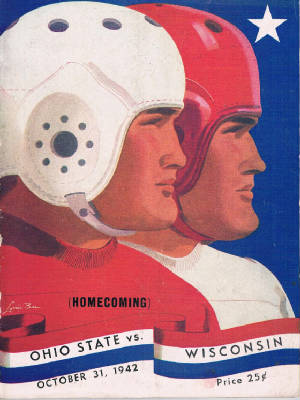
For two bits, fans could
treat themselves to the game program before the
Halloween showdown for the Big Ten lead.
along from someone on the field. Regardless,
the report and Fekete’s alleged remarks got widespread play after the fact.
The
Badgers had been on the field loosening up for nearly a half-hour
when some Buckeyes emerged from the locker room. None of them were
starters. Fekete and his fellow first-stringers finally took the field at 1:52
p.m., or only eight minutes before the scheduled kickoff. The Badgers considered
that insulting, but it wasn’t intended to be. Some of the Buckeyes still
were struggling with dysentery, and Ohio State’s coaching staff
put out the
word that it must have had something to do with
the Madison water. “Everybody
was tired and worn out,”
recalled Charles Csuri, the Buckeyes’ standout
tackle.
“There wasn’t any question that dysentery affected our squad.” Years
later, Csuri remained curious whether the outbreak was caused by something
the Buckeyes ate or drank before they left Columbus, during the trip, or after
they arrived in Madison.
Fekete wasn’t
sure, either, but he was adamant that many of the Buckeyes
were
having to make repeated trips to the toilet. “We had dinner on Friday
night in Madison, and maybe we’re not used to that real rich Wisconsin
Dairyland food,” he said years later, laughing. “Whether it was that or the
water on the train, that Saturday morning, I would say most of the team had
dysentery.”
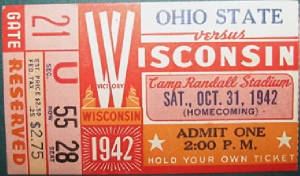
Early-arriving fans got to see the 150-member marching band parade into
the stadium with the Navy men from the radio communications school and
the WAVES in formation behind them. Men from the Army Air Forces technical
school also sat together in one section.
College
crowds everywhere were beginning to look like those traditionally
at Army-Navy games.
★ ★ ★
London, Oct. 31 (AP)—Fifty German bombers smashed with bombs
and machine guns at southeastern England Saturday in the biggest Nazi
attack since the 1940 Battle of Britain, concentrating their assault on
shopper-crowded streets at Canterbury, where Mrs. Franklin D. Roosevelt
was a visitor only Friday. Roaring in at dusk, the raiders dropped
bombs in haphazard fashion and machine-gunned a working class area
and then a shopping street.
★ ★ ★
The game was still scoreless when the Badgers began their third possession
from the Wisconsin
20. On the first play, Elroy Hirsch took the snap
and
started to his right. Pat Harder escorted him, focusing on Ohio State
star George Lynn. Harder leveled Lynn, and Hirsch hurdled them both and
was in the open field. Looking at a picture of that play years later, Hirsch
laughed. “It’s amazing what fear can do,”
he said.
With the help of other blocks from Bob Hanzlik and Bob Baumann,
Hirsch made it to the Ohio State 21 for a 59-yard gain
before Buckeye
Tommy James pulled him down.
The State Journal ’s Willard R. Smith said on that play Hirsch ran “like a scared jackrabbit
on the desert with only sagebrush
and cactus
to hinder him.” (“Jackrabbit” Hirsch didn’t catch on.)
The
scribes noticed that Otto Hirsch, Elroy’s father, was sitting in front
of the press box, and they watched his reaction to the plays on the field,
especially Elroy’s runs. They noted that Otto missed the start of the
long run
because he was retrieving a feather
that had blown out of his hat. After the
run,
he hollered to his son, “You should have gone all the way!”
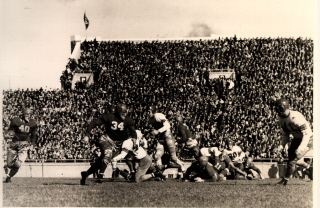
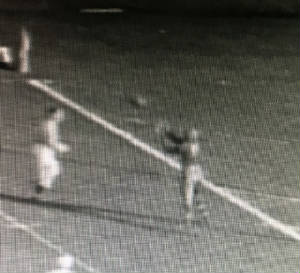
Elroy Hirsch (40) is about
to take advantage of a crushing block from Pat Harder
(34) and break into the open field for the long gain that set up the Badgers’ first
touchdown against Ohio State.
A few plays later,
Harder scored from the 1. Hirsch pulled Harder out of that pile and hugged the rugged fullback. If you needed a yard, you gave the
ball to Harder, and none of the Badgers begrudged that. Harder’s
extra point
gave the Badgers a 7–0 lead with 13:36
left in the first half.
With Schreiner sealing one side, the Buckeyes couldn’t move against the
Badgers. Wisconsin threatened to get the lead to two touchdowns, but the
Buckeyes managed to bat down a Hirsch pass intended for Schreiner on the
goal line, and the Badgers settled for a 37-yard Harder field goal to
make it
10–0. That’s the way it stood at the
half.
Thirty
more minutes, the Badgers told themselves—and each other—in the locker room.
On the field, the Homecoming festivities were altered for
the times. At
one point, part of the band started to spell
out OHIO, mimicking the Ohio
State band’s famous maneuver,
and the stunned Wisconsin fans booed. Long
before those band
members could get to the conclusion, the dotting of the
“I,”
the rest of the band formed a tank, “ran over” the Ohio formation, and
“flattened” it. The crowd laughed and cheered.
The halftime program was a tribute
to former Wisconsin students and
residents serving in the
military, and representatives of the Marines, Army,
and Navy
made speeches. After each one, the band played the appropriate
song—“The
Marine’s Hymn,” “Anchors Aweigh,” or “You’re in the Army
Now.”
The Marine representative was Lieutenant Colonel Chester
L. Fordney,
chief of the Central Recruiting District. “Wisconsin’s
men are fighting men,”
he told the crowd and the international
radio audience that included U.S.
troops around the world.
“They are demonstrating that on the football field
today.
But Wisconsin men also are serving from the Halls of Montezuma to
the shores of Tripoli.”
He probably knew that many of the Badgers had signed up for the Marine
Reserves.
As the halftime intermission ended, a group of Wisconsin
fans turned to
the broadcast booth in the press box and taunted
NBC’s Bill Stern, who on
the radio earlier in the week
had picked Ohio State to win.
But the game was far from over.
★ ★ ★
On their second possession of the second half, the Buckeyes marched 96
yards for the touchdown that got them within 3 points. Fekete scored the
touchdown on a 4-yard plunge, and the Badgers were served notice that the favorites weren’t going
to fold.
Hirsch and Schreiner put it away, though—through the air. Hirsch hit
Schreiner for 12 yards to get the Badgers within striking distance. Then,
from the Buckeye 14, Hirsch faked a run to the right and got off a floater for
Schreiner, who was wide open moving toward the goal line. Recalled the
other
end, Bob Hanzlik: “Dave bobbled the ball, he was all by himself and
almost dropped it, but—and
this was typical Schreiner—he overcame it.”
Schreiner drew in the ball and the Badgers were in control.
The Harder conversion kick made it 17–7. A Hirsch interception ended
the last Ohio State threat, and bedlam broke loose at the final gun.
The Badgers’ stars shone, beginning with Hirsch’s 118 yards on only 13
carries. His Ohio State counterpart, Paul Sarringhaus, had 55 yards on the
same number of attempts. And Harder won the battle of fullbacks, outgaining
Fekete 97–65. Schreiner again was the hero defensively, and the
Badger
coaches later determined from film study that the
Buckeyes had gained only
4 yards around his end. When the
Badgers were on defense, he was working
against Ohio State
sophomore tackle Bill Willis, who went on to be an
All-American
in 1943 and 1944. “The guy he was going against was an All-
American, and Dave put him on his butt,” recalled Erv Kissling, the reserve
halfback, who watched from the sideline.
With their first victory over Ohio
State since 1918, the Badgers were on
top of the world—and
on track to win their first conference title in thirty
years.
The Badgers had beaten the nation’s number-one-rated team, but there
was so little emphasis on such imaginary malarkey, most of the fans knew
neither of the poll nor the rankings. More important to Wisconsin fans, the
Badgers had taken control of the Big Ten Conference race. After that day’s
games, the Badgers were the only undefeated team in conference play, at
2–0. Ohio State was 3–1, and Illinois, Minnesota, Iowa, and Michigan were
2–1. As long as the Badgers kept winning, they wouldn’t have
to worry about
playing one less conference game than the
Buckeyes.
In the Wisconsin dressing room, Stuhldreher told the boys how proud he
was but that they needed to keep it going. Outside, the scribes couldn’t hear
anything but his final line: “Let’s go all the way!” The boys hollered,
and the
doors opened.
Otto Hirsch was one of the many fathers
in the raucous locker room.
Schreiner paraded with the game
ball, lifted out of the pile at the final gun.
An exhausted
Harder couldn’t keep his balance and needed help tying his
shoes.
The State
Journal talked with Schreiner for a sidebar story. “I don’t believe
we could have won if it hadn’t been for coordinated
teamwork,” Schreiner
was quoted as saying. “This
was distinctly a team victory, and that’s the way
games
should be won. And, boy, I was nervous on that perfect touchdown
pass
from Elroy Hirsch.”
The sign on the locker room chalkboard, scribbled by manager Eugene
Fischer, announced: “Seven down, three to go.”
Stuhldreher
went to the visiting dressing room, but the door still was
closed.
He briefly waited outside with reporters. Paul Brown emerged, spotted
Stuhldreher,
and shook his hand, with the Columbus Dispatch writers, among others, watching closely enough to reproduce the conversation in
print the next morning.
“Congratulations, Harry,” Brown said. “You
had the best ball team—today
at least.”
Responded Stuhldreher, “Thanks, Paul. Sorry it had to be this way.”
He almost sounded as if he meant it.
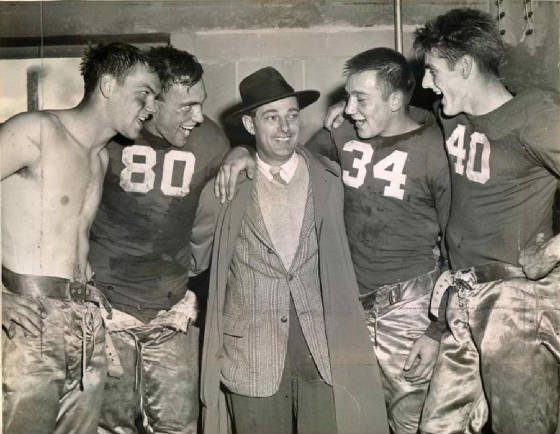
The Badgers’ stars
celebrate the team’s victory over Ohio State with their coach.
Mark Hoskins, Dave Schreiner, Pat Harder, and Elroy Hirsch get giddy with Harry
Stuhldreher, at center.
At first, as
he spoke with reporters, Brown was angry and terse. The Capital
Times said he greeted reporters with: “I’ll
give you a statement. Quote: Wisconsin won the ballgame.
Congratulations. Unquote.” But then he added,
“Wisconsin
has a good ballclub.”
Brown was more philosophical a few minutes later when he talked with
Columbus reporters in the dressing room. “You can’t take anything away
from Wisconsin,” he said, according to the Columbus Dispatch. “They
have a great football team and we have an ordinary one. Today
they were better
than we were. They were inspired and they
had the whole crowd cheering
for them.”
Brown said a loss removed some of the pressure. “I had no dreams. I kept
saying it would come sooner or later. It just wasn’t to be. From the time we
left home, even in practice things have been funny. Everything has conspired
to do us wrong. And this transportation problem and staying in the hotel
in
the town where the game is being played didn’t help
us either.”
The game would become known in Ohio State’s annals as “The Bad Water
Game.”
After the word filtered back to Madison that Brown later
said the Buckeyes
were weakened because of dysentery and
blamed the “bad” water in
Madison, the Badgers
scoffed. Years later, the Badgers still considered that
sour
grapes.
“Brown was complaining that there was so much noise they couldn’t sleep,
but that was a lot of B.S.,” recalled reserve tackle Jack Crabb. “We just beat
the shit out of them.”
Csuri, the Ohio State tackle, was
decisive when asked if Wisconsin saw the
real Buckeyes on
the Camp Randall field. “No,” Csuri said. “I’m convinced
of that.”
Looking back sixty years later, Fekete said the most graphic example of the
Buckeyes’ illness that day came on a play on which Les Horvath carried
the
ball. “I did a spinner play and handed off to Les,”
Fekete said. “Right in front
of our Ohio State bench,
about three Wisconsin guys just buried him. He
got up real
slow and walked over to Coach Brown. He said, ‘Coach, I think I
just did something in my pants!’ Paul Brown’s words were, ‘Les, you get back
in there! Better men than you have done something in their pants!’ ”
Bottom line: On the only afternoon when two of the nation’s best 1942
teams were on the field together, Wisconsin was better.
That day, Columbus Dispatch sportswriter Paul Hornung typed
away for his readers. The next morning his story began: “MADISON,
WIS.,
OCT. 31—The honeymoon is over; the ride on the
clouds is ended; we’re
just common folks again, we
Buckeyes.”
★ ★ ★
A teenaged Badgers fan, Nancy Schumacher, had graduated from high
school in Mineral Point the previous June. She put off going to college
for a
year to work in the Chain Belt plant in Milwaukee,
where she helped make
cases for anti-aircraft guns.
A star-struck Nancy kept a scrapbook of the Badgers’ season. After pasting
down a newspaper picture of Dave Schreiner sitting between two coeds, she
wrote “PHOOEY” beneath it.
Her father, Art, was a former UW letterman
and thus had tickets on the
50-yard line. Nancy sat in other
seats with her mother and planned to join
some of her student
friends on State Street after the game. But when heavy
rains
began, she decided to wait under the stands and was excited to notice
some of the players passing by.
She began asking them for autographs on her program. Bob Baumann,
the big tackle, smiled and teased Nancy that it would be only fair if
she gave
him her autograph, too. Embarrassed at first, she
signed. They talked until
the rains let up, and then they
went their separate ways, Baumann to meet
his fiancée,
Arlene Bahr, and Nancy to hook up with friends.
Nancy discovered that a group of about five hundred fans,
most of them
students, were celebrating under the watchful
eye of Madison police officers,
who had replenished their
tear gas supply and were wondering if the Halloween
atmosphere
might add to the trouble.
“We went uptown and partied at the Park Hotel,” recalled Tom Butler.
“Some guys were tipping over the sand-filled cigarette deals, and
everyone
was snake-dancing up State Street. It was just huge.”
However, the night’s festivities, including the Homecoming dance, went
peacefully.
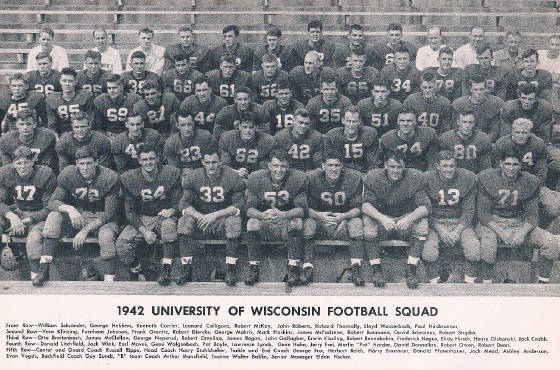
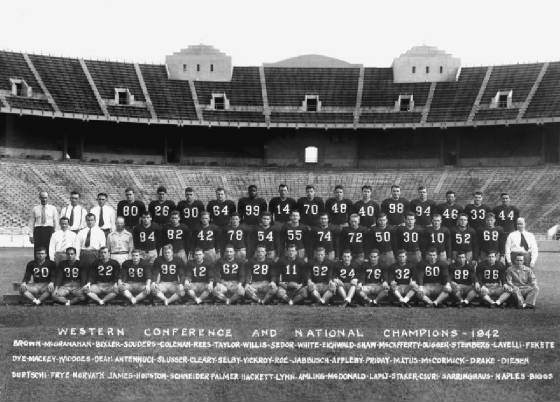
(Many of the men on both teams mentioned here were
World War II heroes, and not all of them returned alive.
More on Third Down and a War to Go.)
